I have also included a You Tube video, in which Nancy discusses her CD.
Tuesday, August 8, 2017
Nancy Kelly's CD Tribute to Mark Murphy
The late jazz vocal master, Mark Murphy, has been an inspiration to so many other singers. One of the finest, who was also one of Mark's favorites, is Nancy Kelly. She is planning to record a CD on which she pays tribute to his musical legacy and is currently raising funds via Kickstarter. If you wish to contribute to this worthy project, please click on the following link: https://www.kickstarter.com/projects/321230614/nancy-kellys-mark-murphy-tribute-cd
I have also included a You Tube video, in which Nancy discusses her CD.
I have also included a You Tube video, in which Nancy discusses her CD.

Saturday, April 2, 2016
"Spring Feelings" with Misha Tsiganov

Misha Tsiganov, who has turned up in earlier blogposts, is back with a lovely new recording, "Spring Feelings." It has been reviewed by Cyrill Moshkow, in the March 2016 edition of the jazz portal, Jazz.Ru. I have included, below, a translation into English from the original Russian:
"Dutch producer Gerry Teekens, the head of Criss Cross Jazz, has the amazing talent to support and record in the top New York recording studios the best projects of the masters of jazz, who are gathered in the capital of the jazz world. Many of them constantly play with one another simultaneously on half a dozen projects. And so the second solo album which is being released on Criss Cross by Misha Tsiganov, a New York pianist originally from Leningrad, brings together his own partners from various projects. The outstanding “Russian American” trumpet player, Alex Sipiagin, constantly plays with Tsiganov in duets as well as in number of ensembles. The edgy and consistent drummer, Donald Edwards, is a member of the group Opus 5, with whom Tsiganov toured when substituting for pianist Dave Kikoski. The same applies to saxophonist Seamus Blake, who visited Russia with Manhattan Time Quintet, a joint project of Sipiagin and Tsiganov. Misha also has worked a lot with the experienced Austrian jazz musician, bass player Hans Glawischnig, who like Misha, has been part of the New York jazz scene since the nineties. In short, saying that this is a strong ensemble consisting of first-rate soloists is actually saying nothing. The main thing is that these masters are united by Tsiganov’s music. The album includes four originals by Tsiganov and four adaptations of jazz standards which stylistically and aesthetically sound as an organic whole. It is a powerful portrait of modern, not museum-nostalgic, striving into the future, New York mainstream jazz. Complex math puzzles and carefully calculated harmonic schemes connect with beautiful melodies, accessible even to an unprepared listener, in an energetically turbulent rhythmic environment that grabs the listener and carries him to breathtaking heights of musical virtuosity, sometimes almost head over heels. These virtuosos do not merely display high mastery - mastery is just the means- the means to convey emotions and share the joy of clever, beautiful full of ideas music."
Two reviews of “Spring Feelings” also appear in the March
2016 issue of AllAboutJazz:
"…pianist extraordinaire Misha Tsiganov… presenting a
superb selection of five outrageous originals and four reimagined standards...
another marvelous foray on the keys…" (Edward Blanco)
"…Tsiganov explores a new approach to quintet orchestration…
really remarkable music… From conception to execution, this music succeeds on
all fronts." (Andrew Luhn)
You can get an MP3 of “Spring Feelings” from iTunes:
Furthermore, the recording is available in both MP3 and CD
formats at Amazon:
For further information about Misha and his music, check out his website: http://www.mishajazz.com.
Sunday, March 20, 2016
Honoring the Jazz Daddy

On Monday, March 14, 2016, I spoke at Mark Murphy's memorial, which took place at St. Peter's Church in New York City. It was a very emotional event, which packed the venue with friends, including those who were themselves jazz artists. In attendance were also many fans, who did not know him personally but had been moved by the legendary vocalist's music.
As a slide show of pictures was projected on the back wall, other singers and musicians performed songs which were closely associated with Mark. The performances were bridged with narration (thanks to writer James Gavin, who stepped in at the last minute). These were supplemented by longer recollections from colleagues and family members, about Mark's life and career. I've included, below, the program, which lists the songs, as well as the names of everybody who participated.

Here is my own brief contribution, about my dear, life-changing friend. It was difficult to put my feelings into words. I hope I have succeeded.
"I am not
used to speaking before so many people, but I’ll do my best! I am neither a performer nor a published
writer on jazz, so my experience with Mark Murphy is somewhat different from
most of those you will have heard today.
When I
entered the Iridium in June 2004, I never dreamed it would lead to a friendship
that grew ever deeper with the passing years.
Mark was just one of many singers whom I enjoyed hearing, though I had
never been to one of his gigs. To say
that this experience was life-altering, is an understatement.
The Mark
Murphy I came to know had many traits which might be unexpected, by those who
only related to him as a singer. He was
the man who hipped me to the History Channel show, “American Pickers,” because
he was into antiques. He was obsessed
with watching movies, especially classics starring Hedy Lamarr, Joan Crawford
and Eleanor Powell. Mark did not read
novels only by Jack Kerouac, but also loved to dig into mysteries. (When I gave him a copy of a jazz mystery set
in Vegas, he said that Bill Moody’s description of the music scene reminded him
of his gig at the Four Queens.) He was
fascinated with extraterrestrials and folks who had served in WWII. Plus, he never ceased to love nature, in
particular, flowers, trees and bodies of water.
The thing
I’ll always remember most about Mark, however, was that the music was
constantly inside him, as regular as breathing.
I was told he once sang to an eagle flying over his log cabin. (Yes, folks, he lived in a log cabin.) I personally witnessed him scatting to a tiny
frog. Mark would make up songs while
crossing the street or waiting for a bus.
On one occasion, in 2013, he sat at his regular table in the dining room
of the Actors Home and sang to me the entire first verse of “You Are My
Sunshine,” perfectly.
Even, when
illness began to overtake him, Mark never lost his feeling for the music. I would play him CDs and DVDs of singers and
instrumentalists, ranging from Miles Davis and Maria Callas to performers new
to him. He would react in one of two
ways: either smiling broadly with his
eyes open and dancing with delight, or else he would close them, as he seemed
to drink in what he was hearing. If the
tracks were from his own albums, Mark would move his hands, as though he was
performing on the stage. He would
sometimes move his lips, singing silently to himself.
On the
Saturday before he passed away. I asked
him what he wanted to hear and he responded, “You know what I like.” So I put on “Maiden Voyage” by Herbie
Hancock, then “Speak No Evil’ by Wayne Shorter.
As Mark listened, I looked into his soulful eyes and saw his inner
beauty come out.
Mark Murphy
was a great man yet so down to earth, a man and a boy simultaneously. Yet, in spite of all he went through, he
never lost his dignity. It was like
being in the presence of a great guru, one who exuded music until he took his
last breath."

Sunday, February 17, 2013
Misha's Story

A while back, one of my past blogpost subjects, Misha Tsiganov, sent me an English language translation of an article on him, which originally appeared in a Russian magazine, Jazz.Ru, in 2007. Finally, here it is for everybody else to read as well:
It all began with a white envelope bearing Berklee College of Music logo in the left upper corner I found in my mailbox one beautiful morning.
In Leningrad in 1990, my friends offered to deliver a tape with my playing the piano to Berklee in Boston. At the time this was totally unexpected since I had no material I considered worthy of being sent. Initially, I ignored the offer, but after being pressured by friends, I found a recording that my brother Alexei, who plays the vibraphone, and I had recently made and gave them the tape without any particular hope for success. I was lucky. Gary Burton, the chairman of the Jazz Department who was almost impossible to find at his office since he was always on tour, happened to be in his room, took the tape, and promised to listen to it. Later he said that we were very fortunate because if he had not been in his office, the tape would have ended up in the archives and would probably have been lost.
So on that morning I went to Mussorgsky College of Music as usual, checking my mailbox on the way. There was an envelope from Berklee. By the way, I still have this letter in safe keeping. In the letter Gary Burton wrote that he liked our playing a lot, that we showed much promise, and that we must continue our education at Berklee. He also promised to help us get a scholarship. As I read the letter, I couldn’t believe my eyes. After that, correspondence came from Berklee about the scholarship and with information that the school would take care of the travel papers and other matters pertaining to our coming here.
It was roughly a year later when my brother and I arrived in America, the land of jazz. The first man I saw in the crowd waiting for arrivals at the New York airport was a great Russian saxophonist Igor Butman full of energy and optimism. Seeing him instilled hope. Since we were whisked off so fast in a car to Boston and to our new life, we were unable to have even a fleeting look at New York.
We arrived to Boston the same day. Gary Burton did help us. Even though nobody got a full scholarship that year, both Alexei and I were offered $4,000 a piece. Since the tuition for a semester at that time was $5,000, each of us was $1,000 short, and for us this was an unattainable amount. Clearly, we had misunderstood something in our correspondence with Berklee, for we had been led to believe that we would be able to pay the lacking funds by working at the college. However, this wasn’t the case, so we had to postpone studying at Berklee indefinitely.
The three of us (my brother and I had been joined by a student from Latvia) settled in a small room in the attic of a dentist’s home. Since the dentist who had studied Russian needed practice with the language, he periodically came to us to talk, and communicating with him in our language was how we paid our rent.
Hard times began. Since we had no work permit, we had to play in the subway stations and on the street. When one puts his instruments on a street for the first time, it is not a good feeling. We had to “break” ourselves. It’s hard to to suddenly feel like a nobody and have to play and collect money in a hat after having given serious concerts in big concert halls in St. Petersburg, after receiving applause and signing autographs, and after having our posters displayed all over town. However, we knew that if we made no money, we wouldn’t eat.
In America, almost everyone starts at ground zero no matter who he was at home, and we surely started there. Every day the money was growing shorter. Once we went to a supermarket and filled a big shopping cart with pasta. When we started to pay, the cashier looked at us as if we were from another planet. She had never seen anybody buying so much pasta. When we saw how perplexed she was, we told her that today the store had a good sale on pasta and that it was cheaper than ever. The cashier said that today they did in fact have an unprecedented sale on pasta. Hearing that, we went back and bought all the pasta we could find in the supermarket. In our room the boxes of pasta lined one of the walls from floor to ceiling. Later, as we moved from apartment to apartment, instead of bringing furniture with us, we brought pasta.
In Boston I often associated with a great Russian pianist Eugene Maslov. He had already been in America three years, and many people knew him. I often went to his concerts where he introduced me to the best musicians in Boston. I began making some contacts and gave my first concerts at jazz clubs. For the first time I understood what capitalism is. At the end of the 80s when I performed at festivals and in clubs in Russia, my salary never depended on the number of listeners. Here, though, if people didn’t come, I made nothing. Of course, this was not always true, but in my case it was. I remember making a giant pile of ads and pasting them wherever possible all over town. This scheme often worked, for people came to hear me play.
The world is not without good people, so we eventually found money for the rest of our tuition for Berklee. I loved studying, but getting experience performing was the most valuable part of being at Berklee.
In 1993, thanks to drummer Oleg Butman for his recommendation, I was offered a steady job in New York City. I had always relished the idea of moving there, but until then, I had not had the opportunity. My life in this incredible city started with a great trumpeter Alex Sipiagin, who met me at the bus station in the middle of Manhattan on Forty-Second Street. As we exited the station, I looked around and asked where Manhattan was, still not realizing that I was already there. We walked all of Manhattan on foot and strolled in the Village where Sasha showed me some of the famous jazz clubs, such as “Blue Note,” “Village Vanguard,” and “Sweet Basil.”
In the evening Alex and bassist Boris Kozlov took me to a Russian restaurant for an audition. I was hired for the job and promised a decent salary. I fully realized where I'd come and what music I’d have to play. Even though the music was far from jazz, it was the price I’d have to pay to move to New York. I had to learn all restaurant repertoire. Later, I often moved from one restaurant to another. For half a year I accompanied famous Russian singer Willie Tokarev. Overall, I worked in the Russian restaurants for eight years. Occasionally, I had stimulating meetings, for Russian restaurants often used talented American singers who worked with stars like Michael Jackson, Stevie Wonder, and Tower of Power. To accompany them was fun. Many other Russian musicians, such as Igor Butman, Sasha Sipiagin, Eugene Maslov, Renat Shaimuhametov, Viacheslav Nazarov, have also gone through working at Russian restaurants. Of course, all of us wanted to enter “Big Jazz,” but it isn’t simple because in the meantime, rent has to be paid, and groceries have to be bought.
While working at the Russian restaurants, I constantly went to jam sessions and spent nights at the jazz clubs. Soon I began to getting jazz gigs and making some useful acquaintances.
In 1998 I was invited to Norman Hedman’s Tropique, a very engaging project. From there I began to give concerts at the jazz clubs, travel to big jazz festivals, and be interviewed on radio and television. In 2000 we recorded an album on Palmetto Records that took sixth place on the USA music charts.
In 2003 on Norman’s recommendation, saxophonist Chico Freeman invited me to play with his band. An interesting note is that in 1990 in Moscow when the biggest Russian jazz festival featuring Freddie Hubbard, Branford Marsalis, Benny Golson, and others took place, Norman Hedman played percussion in Chico Freeman’s group. Naturally, I was in Moscow for all of these days. As I sat in the concert hall, I, of course, couldn’t even imagine that I would eventually join Norman Hedman’s group and a little later Chico Freeman’s group. During the two years I worked with Chico, we recorded an album on Arabesque Records, played in many New York clubs, and traveled to Europe.
Working on the record “Nine Guys From Out Of Town” with the admirable musicians Michael and Randy Brecker was one of the most absorbing events of my recent years. The record contains three of my compositions, and the Brecker brothers play on two of them. Dave Valentine, a famous flute player, also participated. I was especially amazed by Michael Brecker’s scrupulousness and need for perfection. After playing solo on one of my compositions, he asked for it to be saved because he wanted to record himself again using the same accompaniment. Doing so is not difficult with modern technology. Then he had his performance recorded for the third, fourth, and fifth times. In the end, none of his solos satisfied him completely, so he eventually suggested that we choose the version we liked most. We couldn’t understand him because to us all of his solos sounded perfect. Michael, though, gave me a lesson on how demanding one should be toward one’s work.
Following Chico Freeman’s recommendation, Joe Chambers invited me to his band. Joe is a legendary drummer who has recorded a huge number of records with such outstanding musicians as Chick Corea, Wayne Shorter, Freddie Hubbard, McCoy Tyner, Joe Henderson, Bobby Hutcherson, Charles Mingus, Chet Baker, Hubert Laws, and Tommy Flanagan, and others. Since I had listened to and studied Chick Corea’s “Tones for Joan’s Bones” and Wayne Shorter’s “Adam’s Apple” with Joe Chambers on the drums long before coming to the USA, Joe’s offer was unbelievable.
In my many years spent in the USA, I understood that in most cases only recommendations will help a musician get anywhere. Somebody who knows you well mentions you to somebody else. Then this somebody calls you and offers you something, and so it goes. Gradually, your connections grow, more “necessary” people know about you, and your chances for career advancement increase.
Since 2004 I’ve been working with Joe Chambers. During this time we have played in many New York clubs and also recorded the album “The Outlaws” on Savant Records. I think that our trip to Greece was one of the most unforgettable events. While there, we played in Athens at the Half Note Jazz Club seven days in a row with Joe Chambers on the drums, Gary Bartz on saxophone, Dwayne Burno on bass, and me on the piano. In these seven days I came to understand more about jazz than I had in the previous ten years, for a musician gains priceless performing experience only by going onstage and playing every day with other musicians who are far superior to him rather than by just meeting them accidentally at jam sessions once a year. In fact, I know many phenomenally gifted musicians whose lives have prevented them from gaining sufficient performance experience. I also know talented but not spectacularly gifted musicians whose fate has given them the chance to share the stage constantly with great jazz masters. As a result, in time the latter musicians greatly surpass the first.
I think that constant practice with more experienced musicians is most important in jazz. When you find yourself in an extreme situation where you have no right to play below the level of the musicians sharing the stage expect from you, you suddenly discover new resources you possibly didn’t even suspect you had. It seems as if you catch a string that pulls out “hidden” reserves. If you were in this situation just once, it’s possible that you caught this string but most likely didn’t understand how you did it, but if you find yourself doing this every day, you begin to meld into the state of mind when this indescribably complex sensation of you and music as one takes place. When you can reach that state at will, you can consider yourself a real master from that moment on.
In St. Petersburg I acquired invaluable experience while constantly jamming with a famous Russian multi-instrumentalist David Goloschokin and working in Valery Zuikov Band. I will never forget how I entered the stage of the Jazz Philarmonic Hall for the umpteenth time to play with David’s group. When my time to solo came, I started to play. David turned to me and said or rather ordered, “Swing it; swing it!” I understood that if I didn’t swing it, I’d be in trouble. When saxophonist Valery Zuikov invited me to play with his band, I had an opportunity to play with the best St. Petersburg soloists, such as trumpeters Alexander Berenson and Boris Romanov, guitarist Alexander Starostenko, and others. I will always remember Goloschokin and Zuikov with a special gratitude, for what they gave me is priceless.
I’ve been living in New York City for many years now, and I really love this city. I love it because Charlie Parker, Dizzy Gillespie, and Thelonious Monk have created their amazing art on its streets. I love New York for its cutthroat competition which won’t allow me to relax and which constantly pushes me to grow. New York is unquestionably the world’s jazz capital. Many musicians who achieved high results in jazz come here from all over the world to test their skills. For this reason many brilliant jazz musicians live in New York, competing with one another. There isn’t enough work for everybody, and a kind of “arms race” takes place. In this “race” musicians “arm” themselves with knowledge, technology, and experience to achieve a higher level of playing.
Quite recently, I visited Russia. In St. Petersburg my group performed at the Theater of Estrada at a jazz festival organized by Kvadrat Jazz Club. We played as a quartet: Andrei Ryabov on the guitar; Dmitry Kolesnik on the bass; Oleg Butman on the drums; and I on the piano. After that we played two concerts in Moscow in Le Club. There we were joined by Craig Handy, a great New York saxophonist. I had the best of impressions regarding the trip and would like to thank everyone for such a warm reception. I was very glad to see Vladimir Feyertag and Nathan Leytes. It felt as if I had dipped for a moment into the good old times. I have to admit that I was pleasantly surprised by the skill of the young Russian jazz musicians whose level of playing has grown considerably in the past 15-20 years. In fact, some St. Petersburg and Moscow guys play on a solid New York level. I believe that Russian musicians will always be able to pave their way to jazz heights and take a deserving place in the world jazz scene.
In case any of you haven't yet read Misha Tsiganov's original blogpost, you can find it here: http://www.jazzsaints.blogspot.com/2010/08/russian-born-misha-tsiganov-is-one-of.html.
Monday, November 5, 2012
Chris Wabich - Break the Mold
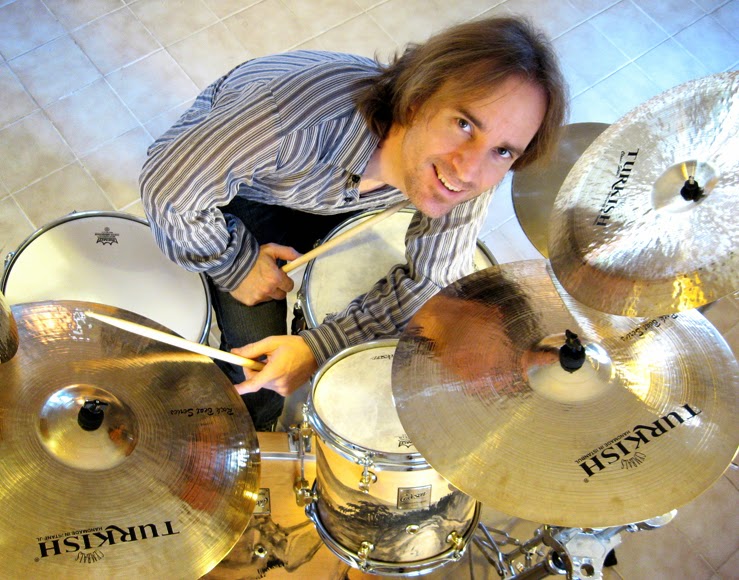
You can find the podcast at iTunes through this link:
https://itunes.apple.com/us/podcast/episode-33-chris-wabich/id495443210?i=123572602
Important news about one of my previous interview subjects, drummer Chris Wabich! His podcast for Break the Mold came out today. Chris recorded this when he was just off the road and jet lagged, so he discusses multiple topics at random even MORE than usual!
You can find the podcast at iTunes through this link:
https://itunes.apple.com/us/podcast/episode-33-chris-wabich/id495443210?i=123572602
Wednesday, June 20, 2012
The Two Questions: Summertime Bass Edition

It's always nice when you go to a jazz performer's gig and find yourself equally impressed by the playing of their sidemen. That's how I first encountered bassist Boris Koslov. He was with the Misha Piatigorsky band, backing Mark Murphy at a NYC gig. My friend and I actually paid rapt attention during the bass solos!
I soon learned that there are many more sides to Boris' music. He performs with various configurations of the Mingus band, generally on Monday nights at Jazz Standard. (Often you can find him playing Mingus' own lion-headed bass.) He's been involved in the popular BeatleJazz project and is co-leader of Opus V, along with Alex Sipiagin, Seamus Blake, Dave Kikoski and Donald Edwards. (Allow me a little plug for the latter: they've just done a second recording for Criss Cross and will be touring in August.) Among the many other jazz artists he's worked with are Jaleel Shaw, George Colligan, Bobby Watson, James Moody, Benny Golson, Donny McCaslin, Brian Lynch, Ray Vega, Eddie Palmieri, Michel Petrucciani, Michel Legrand, Joe Locke, Mark Whitfield, Jeff 'Tain' Watts, Robin Eubanks and Urszula Dudziak.
In spite of being such a busy guy, Boris answered my usual two questions, during a break between sets by the Mingus Big Band.
1. What made you decide on a career in music?
Rather hard question because I made the decision
when I was 15. I just loved the way it
felt and I just loved the way the music made me feel and I always thought that,
if it makes me feel so good maybe if I can learn to play it and, you know,
change something to the way I feel I can make other people feel better. Also I kind of felt that it connects people. By the time I was 15, we had a program in
Soviet Union, when you would enter the competition and you could enter college
before finishing your high school after the 8th grade. Then you would finish your high school while
in college, while already getting a professional education. So, I wanted to play bass guitar and at the
same time, I was really into another connecting type of hobby or potential
career, which was transportation, in particular, railroad. I had to make a decision when I was 15 basically,
and I thought I made the right one, because now I am on the plane and train so
much that sometimes now I’m wondering if it’s still my hobby or not. But I thought it was initially all about
connecting people.
2.
What is it you love about jazz that made you
decide to focus on that type of music?
It was the love of jazz definitely. But when I say jazz, I really mean the love
for the time-based music, because I think most of the music that comes out of
folklore: African, Caribbean, Indian,
funk and everything that we know as pop and jazz music in the American music;
it’s all time-based. The notes matter
less than the rhythm. That’s the key
that’s what interestingly enough oftentimes is being overlooked during the jazz
education process, as I see it. And it
took me a while to realize that, but it’s that initial attraction that really
made me move towards jazz. I was
attracted to rock and roll as many young kids initially. We had a very scarce supply of rock and roll
or jazz things back in Soviet Union, and I was also really into Dixieland and
Louie Armstrong and whatever my father had in the house. It’s just the groove or the rhythm that really
got me. And later on, it was the level
of conversation that potentially happens with other players and subsequently,
the audience, that got me really attracted eventually in '91 to the decision to
move to New York and try myself out, where it was basically to learn how to
better groove and deal with time and how to better communicate. I
found myself as sort of like hitting a wall a little bit, because I was invited
to play with all the best bands at the young age of 22/23. They put me "Number 1" Young Jazz Musician, and
I knew that I was very green, very raw.
That’s what decided on my career in New York, as opposed to staying in
my hometown of Moscow.
You can get a good idea of Boris Koslov's marvelous bass technique by watching this video:
http://www.youtube.com/watch?v=6yZ67KvDFX8.
To get even more information on Boris Koslov, go to his site at http://www.borisbass.com.
Wednesday, May 30, 2012
The Two Questions: West Coast Percussion Edition

I first met LA-based drummer Chris Wabich when I attended an NYC gig by an early incarnation of Sketchy Black Dog. However, I soon discovered that he wears many musical hats and crosses many genres. Among the highlights have been a stage production of Frank Zappa's "Joe's Garage", plus the soundtracks of the TV shows, "Malcolm in the Middle", and "American Idol" as well as the film, "Wild California". Furthermore, he has been involved in recordings with such varied performers as Ludacris, Sting, Stanley Jordan, Jimmy Haslip, Lalo Schifrin, Sheila E., Alex Acuna, Turkish superstar Omar Faruk and Prog Rock legends Kevin Ayers, Mike Hoffman and Richard Sinclair. In 2010 Chris participated in Mark Murphy's latest CD, "Never Let Me Go", and he currently is one-half of the World Music duo, Wahid.
During a break from his busy schedule, Chris agreed to answer the usual two questions.
1. Why did you decide on a career in music?Actually i didn't!!! It was a natural series of events. I just loved playing with anyone and everyone as a kid, and it was never enough. my first "real" sort of gigs were when I was 15, winning an audition with the local symphony beating out the local college kids. The same time I started subbing in at local country clubs playing big band music for people in their 60s and 70s who used to actually dance to Tommy Dorsey, Glenn Miller, etc. eventually I was the house drummer in a few places and had no social life as a teenager... I was the kid and all the 60 something year old musicians would try to help me swing better. once I learned the songs it was easy, but before then...sorry guys!!
What's funny is that these days I feel exactly the same way. Whenever I have a performance and the music is good, I'm ready to play even more. sometimes even after a double header or triple header day I feel like "is that all you got? come on!!" however if someone in the band is killing the vibe, I'd rather be a shoe salesman.
2. What is is you love about jazz that made you decide to focus on that type of music?
Jazz for me is about connecting with your emotions. I am a jazz person whether I'm playing rock, latin, or whatever. I think melodically all the time. I want to get inside the songs and weave lines around them. I want to set the mood and play to elevate the song. Being primarily acoustic, jazz leaves more room for me to express color and nuance. when things are unnaturally amplified, it takes the sonic interaction and intent out of how acoustic instruments were meant to blend with each other.
If I'm allowed the space to color and find new things, I'm the happiest person. I also love playing ballads with the right people. that is where the true music comes out, no jiveness or shredding or practiced licks, a one-time performance of color. On the flip side, if my life was just that it would be really boring, to be the tinkly, feel good, in a sweater gentleman... Above all, I'm constantly on the search for the night/gig/band with the "sweetest" grooves and players. It doesn't have to go to the moon and back on every song (which is so common in jazz), just keep the established vibe and make it relevant to YOU. Think of Wayne Shorter 60's... pretty sweet eh?
To see a video of Chris Wabich playing drums during a 2012 performance with Sketchy Black Dog, click here.
Sunday, April 15, 2012
The Kerouac Connection - Amram and Murphy

Jazz and Jack Kerouac have been closely linked ever since the publication of On the Road, with its depiction of Sal Paradise and Dean Moriarty at a West Coast jazz gig. This connection continued in the experimental short, “Pull My Daisy,” which included Kerouac’s off-screen narration while fellow Beats such as Allen Ginsburg and Gregory Corso acted silently on the screen. The score of this film was written by another onscreen participant, musician/composer David Amram. Of all those involved with this project, the last man standing may well be Amram.

Jazz vocalist Mark Murphy also has his own Kerouac connection. While he never directly collaborated with Kerouac, he paid tribute to him in a couple of iconic albums, “Bop for Kerouac” and “Kerouac, Then and Now.” Not only do they contain music inspired by Kerouac and the Beats, but Mark reads selections from some of the writer’s novels, including the haunting ending of On the Road, which precedes the equally-moving Fran Landesman song, “Ballad of the Sad Young Men.”


In my own personal Kerouac connection, I expect to be seeing both Amram and Murphy this coming Saturday. Thinking about this made me realize that not only are both still actively creative artists in their 80s, but they both have gigs coming up very soon.
David Amram is the special guest with Carol Sudhalter’s Astoria Jazz Band (quintet) at Sunnyside Reformed Church this Saturday night, April 21. It begins at 7:00 p.m. and includes a concert, oral history, Q&A and jam session. The address of the venue is 48-03 Skillman Ave., Sunnyside, NY 11104. 718 426 5997. This is a free event made possible (in part) by the Queens Council on the Arts with funds from the Decentralization Program, a regrant program of the New York State Council on the Arts, administered by the Queens Council on the Arts.
Mark Murphy, who turned 80 this past March 14, has been celebrating his milestone in a series of birthday concerts around the world. During the next one, which takes place at New York’s Blue Note Jazz Club on May 21, he will be further celebrated by other singers who are friends and/or have been influenced by the master. Of course, Mark himself is slated to sing a few songs, carefully picked from recordings spanning 50+ years of excellence. The two sets are happening at 8:00 and 10:30 p.m. The club’s address is 131 West 3rd Street, New York, NY 10012. For more information, you can call 212-475-8592 or go to Blue Note-NY’s website at http://www.bluenote.net/newyork/index.shtml.
Jack Kerouac would have turned 90 years old this past March 12. While he no longer walks physically among us, at least it’s nice to know that his legacy still lives on, not just through his books which are being read by the latest generation of free spirits, but through appearances by free-spirited elders such as David Amram and Mark Murphy.
(Photo of Mark Murphy courtesy of The Jazz Paisan)
Jack Kerouac would have turned 90 years old this past March 12. While he no longer walks physically among us, at least it’s nice to know that his legacy still lives on, not just through his books which are being read by the latest generation of free spirits, but through appearances by free-spirited elders such as David Amram and Mark Murphy.
(Photo of Mark Murphy courtesy of The Jazz Paisan)
______________________________________

Monday, January 23, 2012
The Return of Sketchy Black Dog

Sketchy Black Dog, the band that proves jazz, classical and classic rock can co-exist and combine to produce beautiful music, is back to grace the stage of the Iridium in New York City. This is taking place on Thursday, February 2, with two sets at 8:00 and 10:00 p.m. The last time Sketchy (as it's known to its loyal followers) performed in the Big Apple, during the Winter Jazz Fest/APAP week, it packed the clubs with fans who whooped and hollered after each set.
Here's the lineup of marvelous musicians who make up this band:
Misha Piatigorsky, piano
Chris Wabich, drums
Danton Boller, bass
Monica Davis, violin
Hilary Castle, violin
Colin Benn, viola
Agnes Nagy, cello
To see three video examples of the band in performance, click on these links:
Sketchy Black Dog
http://www.vimeo.com/30166637
Open Window
http://www.vimeo.com/30128587
Fala Bicho
http://vimeo.com/30350725
If you want to experience the magic of Sketchy live, get more information at http://theiridium.com/.
Sunday, October 30, 2011
Two Questions: The Australian Edition

Although it was born in the U.S.A, jazz is a music that has spread throughout the globe. As a result, it now has practitioners on every continent, perhaps most significantly, Australia. One of the ultimate examples is pianist Daniel Gassin, who does not fit the stereotype of a "typical" jazz musician, as you will learn from reading his answers to my questions. (Actually, as someone who has gotten to know so many of these performers, I can safely state that there is no such thing as a "typical" jazz musician.)
Now, on to the questions and answers:
1. Why did you decide to start playing music professionally?
First of all I guess one has to define the term "professional." If you take a traditional/financial-based approach to this question, then you'd probably find that the vast majority of professional musicians actually aren't that at all, as they need to supplement their income with a "day gig." For most musicians (in Australia at least) this means teaching music privately, predominantly in high schools. For me, it means working about 30 hours a week as a lawyer (personally I prefer this to music teaching as I think it exercises a different part of the brain, and means that I'm still musically fresh after a day of work).
Turning to the more musical definition of the word (i.e. being able to play to a professional standard) I guess it's just something that has developed organically since I did my first paid gig aged 16. Jazz isn't like golf - you don't just "turn pro" one day! Playing professionally was just a natural progression in my musical development and in following my passion for jazz piano.
2. What is it you love about jazz that made you decide to focus on that type of music?
Firstly (let's be honest, here) I probably lacked the discipline and patience required to perfect the classical pieces that I played when I began learning piano. Often by the time I perfected a piece, I would be thoroughly bored of it, and this feeling of musical staleness counteracted any great feeling of technical satisfaction created by accurately reproducing a bunch of dots on page.
The more I reflect on this question, however (I've been asked it many times), the more I think that I was drawn to jazz because it suits not only my inherent musical strengths (improvisation, interaction, use of the ear) but also my personality and outlook on life. To me jazz is ideal because it retains the purist concept of the dedicated intrumentalist playing "serious" music, but without constantly being mired in the formality and stuffiness of other "highbrow" musical genres (this is not to say that jazz isn't taken seriously by those that perform it).
I am also a great believer in the idea that musicians communicate their true personalities through the music they play, and this is particularly true in jazz given the enormous improvisational scope which the genre offers. This wide scope of musical possibilities and potential decisions is also interesting because it places a real onus on the musicians to make their choices responsibly to create quality, meaningful music. It is by making the right decisions (despite having such scope to potentially make the wrong ones) that great jazz musicians can express their wisdom (musical and otherwise).
To see performance videos of Daniel Gassin, go here and here.
For much more info on Daniel than can be included in this post, you can check his website at: www.danielgassin.com.
Sunday, August 7, 2011
Revisiting Sketches of Spain and Other Orchestral Works: Steve Richman

Since the earliest part of its history, there have been fusions of jazz with elements of classical music. Among them are Rhapsody in Blue performed by the Paul Whiteman Orchestra, Ellington's suites and the Third Stream works of Gunther Schuller. One of the most beloved examples, however, is "Sketches of Spain", which was originally performed by Miles Davis with an orchestra and arrangements by Gil Evans. A new version of this masterpiece has recently been recorded with Lew Soloff doing the trumpet parts. The orchestra is conducted by Steve Richman, who is equally adept at straight classical as well as symphonic jazz. He agreed to discuss his career as well as his current projects. My questions have been tweaked to reflect the wide spectrum of his musical endeavors.
1. What made you decide on a career in music?
Well, for starters, I didn’t choose music, music chose me. My parents wanted me to play something unusual, and they had two musician friends, one a bassoonist in the Met Opera, the other a French horn player. I chose the latter since braces on my teeth were slightly less painful to play with. And I was attracted to the beautiful and heroic sound. My father used to listen to light classical music on the weekends, Gilbert and Sullivan, Overtures, etc. But I was crazy about early rock n’ roll. At some point I began to get interested in classical music, and the sensation I remember is that it was already there in me. After university, where I got a degree in English, I went to Manhattan School of Music, doing a Master’s in French horn and conducting. I played in an orchestra in Carnegie Hall for 20 years, but gave it up to pursue my real goal, that of conducting. Some people go to Plan B. I went to Plan A. So in 1979 I founded Harmonie Ensemble New York, which I conduct, made up of the top classical, commercial, and more recently, jazz players in New York. We do symphonic jazz, symphony orchestra, chamber orchestra, chamber music and whatever strikes me as interesting, which is plenty.
2. Before moving on to the project we'll be discussing soon, you worked on quite a few others, including ones purely classical, as well as ones more pop/jazz oriented. Can you discuss a few of these?
I’ve done a very wide variety of repertoire. Among many others, I did a Stravinsky CD which received a Grammy Award nomination. I also worked on a decade-long Dvořák Project, doing benefit concerts to put up a statue of Dvořák in Stuyvesant Square Park, New York City, across the street from where the great Czech composer lived in the 1890’s and composed the famous “New World” Symphony, among other masterpieces. But beginning in the late ‘80s, I began a series of Gershwin concerts at Lincoln Center doing Gershwin’s original orchestrations. All of his works were meddled with after his death, you never hear what Gershwin really wrote in his orchestral music. I did a CD which was released in 2010 called Gershwin by Grofé on the Harmonia Mundi label, which includes the original “jazz band” version of the Rhapsody in Blue as well as some “symphonic jazz” arrangements of Gershwin tunes by Ferde Grofé for the Paul Whiteman Orchestra,. The unbelievable clarinet/sax soloist was 93-year old Al Gallodoro, who had been soloist with the Paul Whiteman Orchestra for 30 years! Jimmy Dorsey called him “the best saxophone player whoever lived.” It was a fantastic experience working with Al. The cd was reviewed by dozens of international publications as the Classical CD of the Year. Just previous to the Gershwin CD, I had done another with a similar title, except it was Grofé and Gershwin Symphonic Jazz on Bridge Records. It included the original Paul Whiteman Orchestra versions of Grofé’s Grand Canyon Suite and Mississippi Suite, as well as a piece Grofé wrote for Al Gallodoro called “Gallodoro’s Serenade” for Alto Sax and Piano, which Al recorded for us when he was 92! Most recently I made yet another departure, when we performed Henry Mancini’s original jazz band version of his music to the ‘50s TV show Peter Gunn, which was a heck of a lot of fun. The musicians loved it (as did the audience) and the solos were fantastic. We might record it in the near future.
3. Let's next discuss your current CD project: "Sketches of Spain". What made you decide to record a new version?
When I was a kid, a close family friend (I actually called him ‘uncle”) who was the top commercial trumpet player in New York, Bernie Glow, played on the original 1959-60 LP recording of the Gil Evans/Miles Davis Sketches of Spain. So I literally grew up with the record. It’s always been one of my favorites. Since we developed a relationship with St. Peter’s (“The Jazz Church”) a few years ago, I’ve been going in a gradually jazzier direction. I thought performing and recording Sketches would be a dream project, and a continuation and expansion of my symphonic jazz explorations. I contacted Anita Evans, Gil Evans’s widow, and asked for recommendations for a trumpet soloist, and she mentioned Lew Soloff, a name well-known to me and many others. Lew had played with Blood, Sweat and Tears, and played with Miles and was soloist in the Gil Evans Orchestra, so I thought he was the perfect guy for the job. We hit it off immediately, and have since become good friends. It was a terrific collaboration and an honor to do the first recording of Sketches of Spain since the original, 50 years before. I was amazed at how popular the original record was, since I was contacting friends and colleagues, both classical and jazz, around the world about the concert. One classical pianist in Prague told me it was his favorite record! Anyway, it was a fantastic experience working with Lew and the great jazz and commercial musicians. And as I said in the liners, we tried to bring something of ourselves to this very special masterpiece, while retaining the unique quality of Gil Evans’ and Miles Davis’ music. The cd came out in late 2010 on the Sheffield Lab label, and has received great press.
4. You have Lew Soloff doing the trumpet parts. What made you decide to choose him?
As I mentioned, Anita Evans, Gil Evans’s widow, recommended Lew highly. Lew brings a very special something to Sketches. We were surprised to find out in the original music, which we used, that much of the trumpet solos were actually written out, though they sound improvised. Gil knew Miles so well, and he was able to amalgamate the classical sources of the Rodrigo Guitar Concierto de Aranjuez, de Falla’s El Amor Brujo, and 3 flamenco ones as well. The combination is magical.
5. Were there any challenges in regards to working with the Gil Evans arrangements?
Gil Evans wrote a unique composition based on Spanish classical and flamenco sources. His orchestration, for a 19 piece band and trumpet solo, is special, and in a category all its own. Gil, like many other jazz musicians, was influenced by 20th century classical music by Stravinsky, Ravel, Debussy, etc.. And vice versa. It was a thrill to work with Gil’s arrangements, since they create such a singular sound world, so evocative of the melancholy, passionate sound of Spanish music. As I mentioned, Gil wrote out many of the solos for Miles; Lew stuck to some of that, but also did many of his own improvisations, so I think we re-created a masterpiece, with our own special stamp on it, while keeping the spirit of the original, which was our goal.
6. Can you speak a bit about the other musicians you worked with here and any interesting stories about the actual recording, engineering, etc.?
Lew basically put the band together, though we used a few of the reed, percussion and brass players that I had worked with. They were all outstanding, but a few merit special mention. Bassist Francois Moutin, who works a lot with Lew, is a fantastic player, doing things I’ve never heard anyone else do; it really added another dimension to the recording. Our trumpet section was fantastic, including Dominic Derasse and Joe Giorgianni, and RJ Kelley leading the French horns. Jimmy Musto did a fine job on drums, and reedman Ron Jannelli played some great bassoon solos. Our engineer/producer, the multi-Grammy winning Adam Abeshouse, with whom I’ve collaborated on several varied recordings, did a great job. He was so excited about the historic project, he invited his family to the sessions. And 90-years young George Avakian, legendary Columbia Records producer, who signed Miles in 1955, attended as well, which was a thrill and an honor. He told me he thought our band sounded better than the original, but I’m not sure that’s for publication. By the way, Lew lost his mouthpiece bag before the sessions, but I think it was a blessing in disguise, since he used one that gave him a richer, deeper sonority perfect for the piece.
7. Do you have any new projects in the works?
Last September (2010) we did a concert called “Ellington Does the Classics” at St. Peter’s, including the Ellington/Strayhorn jazz version of the Tchaikovsky Nutcracker Suite, and Grieg’s Peer Gynt Suite. Both are fantastic; we recorded the Nutcracker and I plan to combine it with the original Tchaikovsky Nutcracker so the classical and jazz versions will be on the same cd, something I think nobody’s ever done before. I’m very excited about it. At the concert, we also did “Take the A Train”, something I never dreamed I’d conduct! What a blast. And the musicians had a great time too. There were a number of stars playing, including Lew Tabackin on tenor sax, George Cables, piano, and Victor Lewis, drums. You can hear the tremendous energy and enthusiasm on the recording coming through loud and clear. By the way, there’s an interesting coincidental tie-in on my last few projects. Dvořák taught the future teachers of Copland, Gershwin, and Ellington, which happen to be the last three composers I recorded!
For more information about Steve Richman and his fine musical organization, Harmonie Ensemble New York, please check out the following website: http://www.harmonieensembleny.com/.
Monday, July 4, 2011
Life is Good: another opportunity to hear a living jazz vocal legend in NYC

I'm quoting this verbatim from someone else's post, because I couldn't express things better.
"Legendary jazz vocalist Mark Murphy still has the magic - just ask anyone who's seen him recently. He exudes class, charm, sophistication, and originality. The kicker: the man's voice is still golden and rich, and can truly create magic.
This special Sunday summer evening at Birdland featuring his quartet, featuring pianist George Mesterhazy for two sets of gorgeous singing and expert playing, delivered with true soul by a master.
Get your tickets now, as you can be sure every vocalist in New York will be there!"
Birdland
315 W. 44th Street
New York, NY 10036
Sunday, July 24
Two Sets, 9 pm and 11 pm
Tickets: 212-581-3080
http://www.birdlandjazz.com/event/44949/
(Since my birthday happens to be just a few days prior, this is one of the best birthday presents I could ever get--the opportunity to hear Mark Murphy at the top of his game, once again!)
Wednesday, June 15, 2011
Sketchy Black Dog - Father's Day gig

Sketchy Black Dog has a very special gig coming up this Sunday at Klavierhaus, a lovely venue where you'll be surrounded by some of the most beautiful pianos in the world, including the one which will be played by the amazing Misha Piatigorsky. But there's more: the strong bass pulse of Danton Boller, the rhythmic genius of Chris Wabich on drums and an exquisite string quartet. You'll marvel at the imaginative and audacious mashup of jazz, rock and classical. Plus there will be a wine reception. What an incredible Father's Day gift this would make for a really hip dad!
6/19 NYC
KLAVIERHAUS, 9pm
tickets: peter@klavierhaus.com
211 West 58th Street between Broadway and 7th Ave.
New York, NY 10019
(480) 789-1313
Sunday, June 5, 2011
Almost time for Mark Murphy's gig...

Just a gentle reminder about Mark's next NYC gig:
ZINC BAR, NYC
Wednesday, June 8, one set only, 9:30 pm
82 West 3rd Street (btw Thompson & Sullivan)
Greenwich Village - New York, NY
Mark will be ably assisted by Misha Piatigorsky on piano, Danton Boller on bass and Chris Wabich on drums. (This is same band that performs with him on his new CD release, "Never Let Me Go".)
Tickets: tel. 212-477-ZINC (9462)
www.zincbar.com
Sunday, May 15, 2011
The Four Questions: Samba Jazz Edition

In the history of jazz there seems to be only a handful of musicians who have excelled in playing it on chromatic harmonica. There may be even fewer who have also mastered playing Brazilian forms, such as samba and choro, on the same instrument. German-born Hendrik Meurkens is a sensitive and lyrical musician who has the soul of a Brasiliero but can easily switch to straight-ahead. Even though he mainly performs on the aforementioned harmonica, he often doubles on vibes, definitely one of the more unusual combinations you'll find on any jazz stage.
I interviewed Hendrik prior to his first set at the Bar Next Door in New York City, before he embarked on a tour that will be keeping him in Europe for the next few months. He was so enthusiastic about discussing his music that the usual interview format has been expanded for this blogpost from two questions to four.
1. Why did you decide on a career in music?
I didn’t decide on a career. It just happened that way. I was interested and the interest became stronger and there was really no room for a regular job basically. So my parents put me in a bank to learn the bank business and after six weeks, I went to my boss and told him that it’s nothing personal but I just don’t have the energy at night after 5:00 to practice so I have to give this up. So it’s really not something that I decided. Just the music became so important that it ended up what I’m doing, although I never really considered a career. It’s more like a calling. It’s not a conscious decision; I just have to do it.
2. What is it you love about jazz that made you decide to focus on that type of music?
I didn’t decide anything. I just heard it and there it was and I needed to do it. Actually, since I’m self-taught I was never involved in classical music, except for a few piano lessons as a kid. So I never really had any formal education in any other kind of music than jazz, because I picked out jazz; I learned it and eventually I went to Berklee for a few years, but when I got there I already kind of knew what I was doing, I guess, and none of this was intentionally decided. It just came to me, it got stronger and stronger and there it is. None of these things has been a conscious decision.
3. Why did you decide to shift your attention gradually to Brazilian jazz and, even though you still sometimes do, of course, regular straight-ahead jazz, why did you decide to focus on the former style more so?
It was, again, not a decision but something that felt natural. For one thing, it has to do with the instrument. Harmonica in straight-ahead jazz—it’s possible, it has its moments, but for me, it’s not the most comfortable instrument. If were to be a saxophone player, I probably would have stayed right in straight-ahead jazz, because I believe that certain instruments go with certain styles. They just feel comfortable like the violin in classical music or the acoustic guitar in Brazilian music. There are certain instruments that are made for a style, and they get the most of the style and the style gets the most out of the instrument. Harmonica in straight-ahead jazz—I don’t think that’s the ideal carry although there are great things that can be done. But in Brazilian music, it seems that the harmonica is a perfect match. In Brazilian music, I never for a minute felt that the harmonica was not the right instrument to play. In jazz, I’m always happy if I have my vibes on stage, just to give it a little break. So, and again Brazilian being a very melodic music, beautiful songs, I like compositions, I like real standards, real compositions vs. just blowing vehicles. I’m not too taken by, you know, blowing vehicles where the tune is not so important and the solo is everything. For me, the solo is not everything. For me, the composition is very important and the jazz solo is part of a whole picture, but it’s not the main thing for me. So Brazilian music gives me more on that end than jazz, although standards, of course, are beautiful—American jazz standards—but the jazz original compositions, not always to me. They seem to lack depth.
4. You just came back a short time ago from Jakarta. Talk a little about playing jazz samba particularly in front of a non-American or non-Brazilian audience.
The Brazilian audience does not necessarily have to be the perfect audience for my music, because Brazilians have a very clear picture of how they like to hear Brazilian music, and I might not fit that. And also, I’m really not playing Brazilian music. I play my own version of Brazilian jazz which is really neither jazz nor is it really Brazilian music. It’s kind of my version of it. And I travel a lot and there are countries that have a very natural perception of music without any prejudice, without any clichés to be met. The Russian audience is one of them. A lot of the Asian audience are like that. They just appreciate good music. They are entertained by good music, and if they happen to like my music, I take it as a compliment. American and European audiences are more educated, more experienced. They usually have an opinion before they even listen, especially the Europeans. They know a lot about the music and they already come in with a certain load of knowledge that makes them a critical audience. The Asian audience or other audience in countries where they don’t have that much jazz are much more open. They just enjoy it, and for me that is the perfect way because jazz started as entertainment and I hope it will continue as entertainment because that’s what it is. You go to a club, you have your dinner and your drink and you go and listen and enjoy, and it’s not meant to be an analyzed and criticized. That for me is not the right approach. And countries like Indonesia, Russia, other countries in Asia, sometimes South America—they just like it, and that’s a good thing.
To see an example of Hendrik Meurkens playing one of his originals, a beautiful Brazilian choro called "Menina na Janela (Choro No. 5)", on harmonica, click on this link. You can also see him on vibes, playing "Slidin", a straight-ahead original, by clicking here.
For more information on Hendrik's music, including his recordings, and to find out where he's gigging next, check out his website, http://www.hendrikmeurkens.com/.
Subscribe to:
Posts (Atom)