Sunday, May 15, 2011

The Four Questions: Samba Jazz Edition


In the history of jazz there seems to be only a handful of musicians who have excelled in playing it on chromatic harmonica. There may be even fewer who have also mastered playing Brazilian forms, such as samba and choro, on the same instrument. German-born Hendrik Meurkens is a sensitive and lyrical musician who has the soul of a Brasiliero but can easily switch to straight-ahead. Even though he mainly performs on the aforementioned harmonica, he often doubles on vibes, definitely one of the more unusual combinations you'll find on any jazz stage.

I interviewed Hendrik prior to his first set at the Bar Next Door in New York City, before he embarked on a tour that will be keeping him in Europe for the next few months. He was so enthusiastic about discussing his music that the usual interview format has been expanded for this blogpost from two questions to four.


1. Why did you decide on a career in music?

I didn’t decide on a career. It just happened that way. I was interested and the interest became stronger and there was really no room for a regular job basically. So my parents put me in a bank to learn the bank business and after six weeks, I went to my boss and told him that it’s nothing personal but I just don’t have the energy at night after 5:00 to practice so I have to give this up. So it’s really not something that I decided. Just the music became so important that it ended up what I’m doing, although I never really considered a career. It’s more like a calling. It’s not a conscious decision; I just have to do it.


2. What is it you love about jazz that made you decide to focus on that type of music?

I didn’t decide anything. I just heard it and there it was and I needed to do it. Actually, since I’m self-taught I was never involved in classical music, except for a few piano lessons as a kid. So I never really had any formal education in any other kind of music than jazz, because I picked out jazz; I learned it and eventually I went to Berklee for a few years, but when I got there I already kind of knew what I was doing, I guess, and none of this was intentionally decided. It just came to me, it got stronger and stronger and there it is. None of these things has been a conscious decision.


3.
Why did you decide to shift your attention gradually to Brazilian jazz and, even though you still sometimes do, of course, regular straight-ahead jazz, why did you decide to focus on the former style more so?

It was, again, not a decision but something that felt natural. For one thing, it has to do with the instrument. Harmonica in straight-ahead jazz—it’s possible, it has its moments, but for me, it’s not the most comfortable instrument. If were to be a saxophone player, I probably would have stayed right in straight-ahead jazz, because I believe that certain instruments go with certain styles. They just feel comfortable like the violin in classical music or the acoustic guitar in Brazilian music. There are certain instruments that are made for a style, and they get the most of the style and the style gets the most out of the instrument. Harmonica in straight-ahead jazz—I don’t think that’s the ideal carry although there are great things that can be done. But in Brazilian music, it seems that the harmonica is a perfect match. In Brazilian music, I never for a minute felt that the harmonica was not the right instrument to play. In jazz, I’m always happy if I have my vibes on stage, just to give it a little break. So, and again Brazilian being a very melodic music, beautiful songs, I like compositions, I like real standards, real compositions vs. just blowing vehicles. I’m not too taken by, you know, blowing vehicles where the tune is not so important and the solo is everything. For me, the solo is not everything. For me, the composition is very important and the jazz solo is part of a whole picture, but it’s not the main thing for me. So Brazilian music gives me more on that end than jazz, although standards, of course, are beautiful—American jazz standards—but the jazz original compositions, not always to me. They seem to lack depth.


4. You just came back a short time ago from Jakarta. Talk a little about playing jazz samba particularly in front of a non-American or non-Brazilian audience.

The Brazilian audience does not necessarily have to be the perfect audience for my music, because Brazilians have a very clear picture of how they like to hear Brazilian music, and I might not fit that. And also, I’m really not playing Brazilian music. I play my own version of Brazilian jazz which is really neither jazz nor is it really Brazilian music. It’s kind of my version of it. And I travel a lot and there are countries that have a very natural perception of music without any prejudice, without any clichés to be met. The Russian audience is one of them. A lot of the Asian audience are like that. They just appreciate good music. They are entertained by good music, and if they happen to like my music, I take it as a compliment. American and European audiences are more educated, more experienced. They usually have an opinion before they even listen, especially the Europeans. They know a lot about the music and they already come in with a certain load of knowledge that makes them a critical audience. The Asian audience or other audience in countries where they don’t have that much jazz are much more open. They just enjoy it, and for me that is the perfect way because jazz started as entertainment and I hope it will continue as entertainment because that’s what it is. You go to a club, you have your dinner and your drink and you go and listen and enjoy, and it’s not meant to be an analyzed and criticized. That for me is not the right approach. And countries like Indonesia, Russia, other countries in Asia, sometimes South America—they just like it, and that’s a good thing.


To see an example of Hendrik Meurkens playing one of his originals, a beautiful Brazilian choro called "Menina na Janela (Choro No. 5)", on harmonica, click on this link. You can also see him on vibes, playing "Slidin", a straight-ahead original, by clicking here.

For more information on Hendrik's music, including his recordings, and to find out where he's gigging next, check out his website, http://www.hendrikmeurkens.com/.

Wednesday, April 13, 2011

Mark Murphy--the New York State tour!


Mark Murphy is definitely back (not that he ever really left) and has two upcoming gigs right here in New York State. Check out the details for both of them below.


ZINC BAR, NYC
Wednesday, June 8, one set only, 9:30 pm
82 West 3rd Street (btw Thompson & Sullivan)
Greenwich Village New York, NY
Tickets: tel. 212-477-ZINC (9462)
www.zincbar.com


ROCHESTER INTERNATIONAL JAZZ FESTIVAL
Friday, June 10
Two Concerts: 5:30 pm and 7:15 pm
Harro East Ballroom
155 North Chestnut Street
Rochester, NY 14604
(585) 454-0230

Access with ClubPassor purchase a ticket at the door for $20.
No advance sales. Seating is first-come, first-served.
http://www.harroeastballroom.com/

Saturday, March 19, 2011

The Two Questions: Sing into Spring


Jane Stuart is a very creative vocalist who has performed in many different styles of music, but ultimately settled on jazz as the medium for her most personal artistic expression. She just released a new CD, "Don't Look Back" and will be having an official release event at the Kitano in NYC on March 31, 2011.

In the interim, Jane also agreed to be the subject of my latest blogpost. Here are her answers to my questions:


1. Why did you decide on a career in music?

I started writing songs at 3 years old; on the wonderful, old upright piano we had in our 3 room apartment in Jersey City, NJ. I usually remembered these little 4 note ditties and would make my father, mother and older brother my captive audience, on a regular basis.

I just recently started to write, for real, and have an original, “Let It Come To You” on my new CD Don’t Look Back”.

My mother took me to see Peter Pan on Broadway when I was about 7 years old and that did it for me. I remember the moment I said to myself, “I can do that!” …and so I did.

I would create shows in my neighborhood, just like Our Gang/Little Rascals. I was the producer, costume designer (paper plates, crayons, crepe paper etc.), director and of course The Star!

There was no doubt about it. I lived and breathed music and dance and was bossy enough, as a kid, to “produce” my little shows. I now wish I had movies/videos of them.

I was a show biz kid. Went to tap school, in NYC, with fellow tap schoolmates, Christopher Walken, Alan Paul (Manhattan Transfer) and Jeff Conaway. I studied ballet at Carnegie Hall as well as singing and acting. I auditioned for shows, modeling, movies….everything.

From the ages of 7-13 I wanted to be a Broadway star! But when I went on auditions, and there were many, I was always pegged as sounding too jazzy. That’s funny. I would think I was singing a tune very straight and come to realize that I was naturally interpreting a lyric or melody. Nothing outrageous, just a little too stylized for the ‘legit’ crowd.

I did have some success in theater, with my tap dancing and acting skills.
So, in answer to the question, I don’t think I actually made a decision, I just always knew that I was born to do this. May sound corny, but that is the truth.


2. What is it you love about jazz that made you decide to focus on that type of music?

My father died when I was 13. My mother, a legal secretary, worked long, hard hours and my brother was away at school. I spent a lot of time alone. Looking back, I realize that I had a strong jazz sensibility already at that time; I just didn’t have a name for it.

There was a radio show that I loved, called “Symphony Sid“. Sid Torin’s show was my classroom, my refuge and my inspiration. I heard Coltrane, Miles, Nina Simone, Lambert, Hendricks & Ross, Nancy Wilson, Gloria Lynne, James Moody, King Pleasure…you name it. All the greats. The music I would hear on that show, coupled with my tap dancing really informed my natural affinity for the music. I would make up arrangements of old standards I knew, or songs I heard on Sid’s show and sing them in my head while doing a tap routine on my fingers. I remember so many of those songs now, when I am looking for material to sing.

In my long and varied career, I have sung Broadway style, Rock and Roll, R&B, Country,…just about everything except Opera ( I just don’t have the trained voice for that or I would’ve tried that too). Jazz is my nature. I swing, that’s my nature. I feel and interpret a lyric. I have an inner sense of time that allows me to play with time. It’s just the truth for me. I love having the freedom to explore and stretch myself. Jazz really requires that the players listen, listen, listen and respond. At its best, it is a give, give and take and share experience.
There is always so much to learn and step up to. I have so much to learn and I look forward to it.

Ornette Coleman said it best: “Jazz is the only music in which the same note can be played night after night but differently each time."

Following are the complete King Pleasure lyrics to "Jumpin' with Symphony Sid":
"Jumpin' with my boy Sid in the city,
Jumpin' with my boy Sid in the city,
Mr. President of the DeeJay committee,
We're gonna be up all night gettin' with it
We want you to spin the sounds by the minute
From down in the land that's really a-pretty.
"Make everything go real crazy over 'JZ,
Make everything go real crazy over 'JZ,
Play anything cool for me and my baby,
We don't want to think we're listening to Lacy,
It's got to be Prez, Bird, Shearing or the Basie,
The dial is all set right cloo-ose to 80,
Let 'er roll." (JZ" refers to radio station WJZ.)


To watch a video of Jane Stuart performing "Getting to Know You", go to http://www.youtube.com/watch?v=Jti6iKuzV7w.

For more info about Jane Stuart's gigs and recordings, go to www.janestuartmusic.com.

Saturday, March 5, 2011

The Two Questions: Late Winter Edition


Jake Herzog is a daring young guitarist who has managed to blur the line that separates jazz and rock, using the best aspects of each style to create a fresh approach to improvisation. I had the privilege of hearing him live recently in a trio with bassist Harvie S and drummer Victor Jones. The musical interplay among the three of them was fluid and exciting, a true union of heavy metal with straight-ahead.

As a result of this audacious breaking down of the barriers one would normally expect when different genres merge, I was very enthusiastic about getting Jake to participate in my "two questions" interview. So here it is folks!


1. Why did you decide on a career in music?

I think music chose me. If I asked myself, what could I live without, well, I could live without literature, history, or mathematics. I could survive just fine not studying physics, biology, chemistry. But I couldn't keep the small bit of sanity I have left without music. So when it came time to go to college and move on from just being a high school student, music was the only thing I wanted to do.


2. What is it about jazz that made you decide to focus on that type of music?

The spirit of jazz, to me, has always been complete freedom and creativity, that's what improvised music is all about. So, in a phrase, I decided to focus on jazz because, of all the musics (I'm a singer songwriter as well), jazz and improvised music has the most freedom. I love the thrill of unpredictability, chaos and, and when the performer doesn't know more about what will happen next then the audience does. That said, this spirit of jazz is not confined to one language, like bebop, or fusion, or modern jazz. It's in all of them and far beyond. So my whole thing with the rock influence, to me, is that's the next place to go. We had jazz in the 70s that was influenced by the rock bands at the time, so why should jazz today not be influenced by every other style of music. The way I see it, you leave style and language behind and just focus on being creative and moving people with improvisation. The rest doesn't matter. I think if you can do that, Charlie Parker would be proud.


To get a better idea of Jake Hertzog in action, go to his You Tube channel: http://www.youtube.com/user/jakehertzog.

For even more information about Jake's music, check out his website at www.jakehertzog.com.

Friday, January 21, 2011

The Two Questions: Tango Jazz Edition


Since the earliest days when Jelly Roll Morton combined jazz with what he called the "Latin tinge," there has been the incorporation of elements from the music of other cultures. One of the latest and most innovative performers to carry on this tradition is Argentine born bassist and producer, Pablo Aslan. While maintaining the elegance and melancholy of traditional tango, he has brought it into the 21st Century by combining it with contemporary jazz improvisation. Pablo has performed and recorded with a long list of other performers and groups from Argentina and the U.S. Among them are Adrian Iaies, Paquito D’Rivera, Marco Granados, the Afro Latin Jazz Orchestra, Yo Yo Ma, Wynton Marsalis, Shakira, Joe Lovano, Gary Burton, Lalo Schifrin, and the New World Symphony. Pablo has also been involved in many prestigious musical projects such as The Tango Group with composer/pianist Roger Davidson, the New York Buenos Aires Connection and New York Tango Trio with bandoneonist Raul Jaurena, and as featured artist of the Lincoln Center Institute.

Furthermore, Pablo Aslan has done numerous recordings, and his latest release on Zoho Music, "Tango Grill," has been nominated for a Grammy in Latin Jazz.

I was very glad when Pablo agreed to answer my questions. The second has been tweaked to reflect his unique musical vision.


1. Why did you decide on a career in music?

Love of Music made me decide! Besides having a visceral attraction to music since I was a little kid, I discovered as a teenager that I had a certain facility for playing music, particularly the bass. I did not grow up in a musical household, and music education in high school was a joke. I took lessons wherever I could, but had my eye on an education in the US. So the big decision in my life was to leave Argentina as an 18 year old and come to the US. I first came to California to study (UCSC, Cal Arts, UCLA), and after 10 years moved to NY to go into it deeper. Early on in California I started playing gigs (jazz, symphony, latin jazz, tango), and over the years I’ve made my living primarily as a musician. I love the lifestyle, the work, the co-workers. I’ve also worked a bit as a producer, both for live shows and in the studio, and in several aspects of the music business. Music has taken me around the world and introduced me to so many aspects of life and so many great people that my life is richer because of my career choice.


2. What inspired you to blend jazz and tango?

My parent’s record collection had a bit of Beatles, Bossa Nova, Piazzolla , jazz, and classical music, so that’s how I started forming my aesthetic. In my teen years I started buying progressive rock and jazz records (particularly ECM, but also Mingus, Coltrane, etc.), and when I moved to the US, I got into tango (beyond Piazzolla), while I completed my studies in classical music. At some point I became interested in searching for a mode of expression that resonated completely with who I am and what I love about music. In a more general sense, it was a search for identity as an Argentine-American. As much as I loved playing jazz and classical music, I did not see myself being 100% immersed in them as a career. Tango struck me like a lightning bolt and brought it all together, and gave me a creative place to go towards. A deciding moment was to hear bassist Charlie Haden play duets wtih bandoneonist Dino Saluzzi. I felt like the answer to my search was right in front of me. That was in 1986. I’ve been on that path ever since, and I feel fortunate after so many years to have been able to unlock a few doors in what now is generally called Tango Jazz.


To see videos of Pablo in performance, here's a link to his You Tube channel: http://www.youtube.com/user/AvantangoMedia.

To get more information about him than can be included in this short post, go to Pablo's site at www.pabloaslan.com.


Saturday, January 15, 2011

The Two Questions Redux


My latest blogpost subject is the only jazz artist I personally know who has played with Blood Sweat & Tears. His name is Tom Guarna, and he is an extraordinary guitarist who has been sideman with a long list of bands and individual jazz greats including the Yellowjackets, Randy Brecker, Lenny White, Bob Dorough, Buddy DeFranco, Javon Jackson, Les McCann, Joe Locke, the Mingus Orchestra, and Billy Drummond. He has gigged very recently with pianists George Colligan and Kerry Politzer. Tom has led his own groups in clubs such as the Blue Note, Sweet Rhythm, Fat Cat and Smalls. Furthermore, he holds an undergraduate degree from The New School and a Masters Degree from The Juilliard School.

Tom Guarna enthusiastically agreed to answer the familiar two questions. Those answers now follow.


1. Why did you decide on a career in music?

Well, a career in music really decided on me. My father played guitar and would have people over the house to play. He would also take me to band rehearsals. There was a lot of music happening around the house, so when I really developed a serious interest in music in my late teens, it was a natural progression.


2. What is it you love about jazz that made you decide to focus on that type of music?

I grew up listening to classic rock, funk and R and B. Then I got into the classic Jazz Rock groups like Return To Forever and Weather Report and Tony Williams Lifetime. Once I started to research all the artists that these band members worked with, I discovered Miles and Coltrane and I was hooked. I just kept working back from there listening to Bird, Monk, Bud Powell, Ellington, Mingus, etc. I have always loved to improvise. Even when I was playing in rock and funk bands I would always rather play improvised solos rather than play the solos on the recordings. The tunes and wide harmonic palette that jazz offered was something that drew me in as well.


If you'd like to experience Tom Guarna live, he has an upcoming gig with the John Benitez Group. It's happening Monday, January 24th, at the 55 Bar, from 9:30 p.m. to 12:30 a.m.

The next best thing would be to check out a You Tube video of him at Fat Cat, performing his original composition, "Shambleau". You can see it by clicking here.

For further information about Tom and his music, go to his website, www.tomguarna.com .

Sunday, December 5, 2010

Greg Lewis


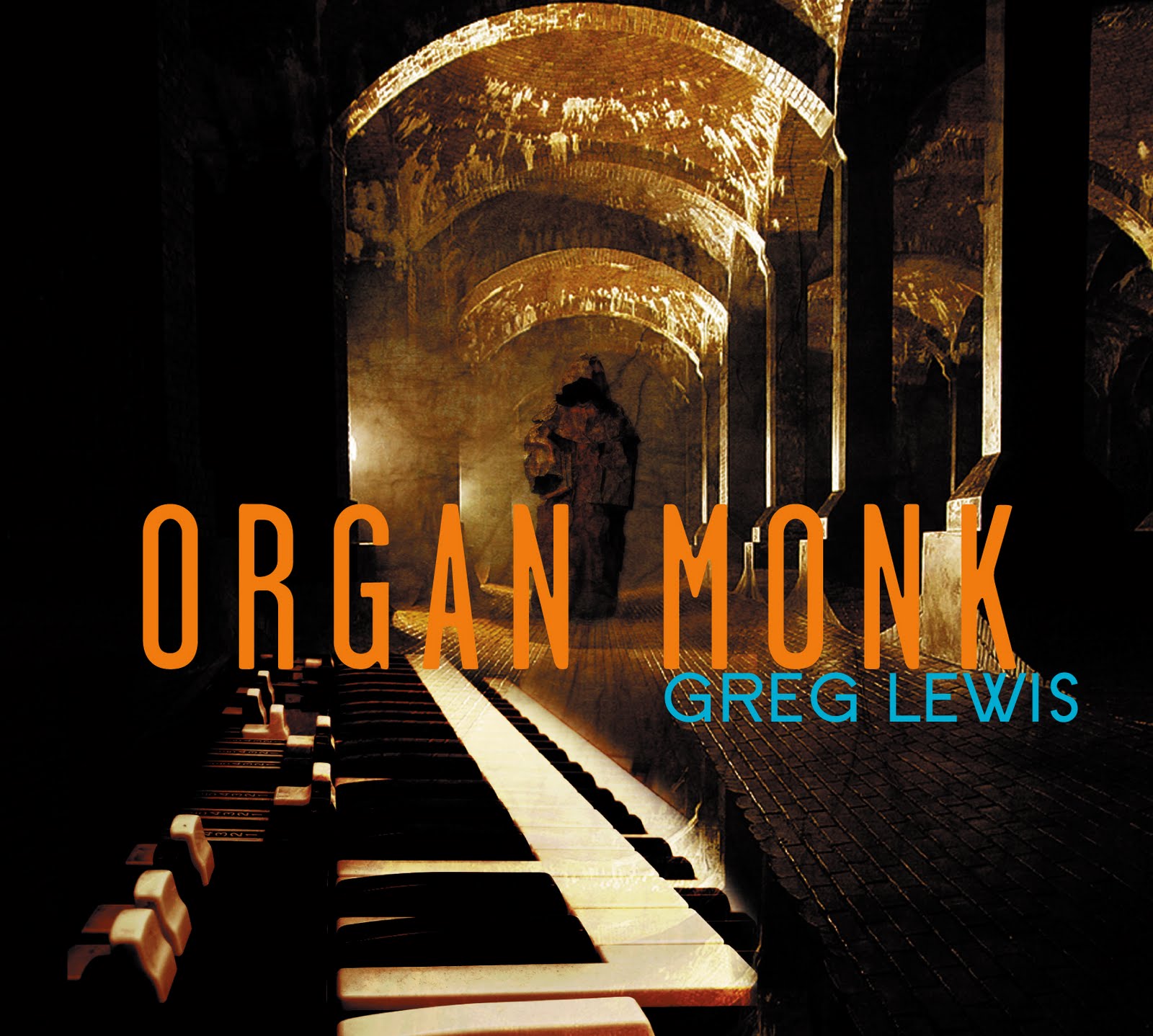
This current post is based on a freewheeling interview with Greg Lewis, one of the most creative jazz organists you’ll ever hear, with a sound all his own. Another one of his passions is the music of Thelonious Monk. A natural result of all this is Greg’s unique and entertaining recent CD, Organ Monk.


Over lunch at a diner in Greenwich Village, we discussed memories of hearing jazz, high school sports, and how Monk influenced him:


I think in a way jazz chose me. Mom said I heard music when I was in her stomach. My grandfather and dad both played piano. Dad would play jazz albums and then try to play the music on the piano. I started on the piano first when I was young. Another of my earliest memories was hearing Coltrane. He was the first musician I ever knew. He was constantly played by my father when I was about 6 or 7, though I thought it was crazy music!

In high school, I played sports and played tuba in the high school band. In sports, I was MVP in football and City champ in wrestling, 190 weight class. They wanted me to go to the Olympics for wrestling, but I liked football better. Also got the JFK Fitness Award and was named Athlete of the Year.

Around 16 or 17, I started liking Monk. I really liked the dissonance. It made him distinct, hearing those funny sounds. My piano chops weren’t good in high school, because all I played was Monk and some r&b. I had a regimen of practicing the piano and figuring how to play tunes by ear.

Everyone expected me to go to college for sports. When I got a full music scholarship for Queensboro Community College, it was just for piano. Eventually went on to The New School for piano studies. I still was always into playing Monk. Even when Roy Hargrove came to the school, he asked, “where’d you learn all that Monk?” I still see him on gigs, ‘cause he plays with Leslie Harrison.

I studied with Jaki Byard, then took lessons with Gil Coggins. When I was sent to sub for an organ gig playing left-hand, I went “what?” Then I started checking all kinds of organ cats.

After a while the conversation turned to discussion of everything organ, including the legends of the music and Hammonds:

Basically I was trying to figure out the organ by listening to those people like Larry Young, who was one of my favorites. Larry Young’s stuff really struck me because first of all you listen to Larry Young, Jimmy Smith, Jack McDuff, Charles Earland—I was even checking out Rhoda Scott. And the list goes on and on. If they were an organ player I was trying to check them out, even to the point where I was checking Chester Thompson and Sly of course. But the one thing that really took to me with Larry Young was that he recorded Monk’s Dream. He was the only one I know of that recorded Monk’s Dream, so when I heard just him and Elvin Jones playing a duet that really made me say, “oh, wait a minute.” And so that’s when, I think, the love came in and I started to obsess over organ. I would play a piano as though I was playing the organ.

One thing I like about the organ. It has so many different sounds, and that’s what’s also intriguing, especially, you know, being a product of the synthesizer era, really the pipe organ was the first synthesizer—really fused sounds, when you think about it. So, I always liked crazy sounds—highs, lows, clicks, cracks. And in some weird way, I think organ is perfect for Monk because, Monk was getting more in-between sounds on the piano. A lot of people say he played in the cracks.

With a pipe organ, you can’t sustain the bass quick enough. The bass is long, so when you play a Hammond, the notes are quicker which is what you need. Cause that stuff that Fats Waller did [on the pipe organ] sounds cool, but it’s weird. But I think that’s the main problem why it sounds weird, because the bassline couldn’t connect quick enough, especially whether it be stride or whether it be walking the bassline, you know the way Jimmy Smith and them did.

I had a Farfisa—that’s one of the first organs I got. I saw it online and got it cheap. That really didn’t do the job, you know. Nothing really works like the Hammond. Lawrence Hammond came up with something special when he made that Hammond organ. No other organ works for the jazz idiom as well.

I believe they sold Hammond to Australia first and then Japan bought it from the company in Australia. But I think it was in the 70s the last Hammonds were made. But they stopped making the Hammond. It was electronic with some tubes and it was kind of cheesy. The B3 and the C3 and the A100 and the RT3 or the 4 are the Hammond organs that work great for jazz because electronically they’re identical. The RT3 has an extra octave on the bass pedals, concave like a pipe organ and the C3 is enclosed so you can’t see the person’s feet, ‘cause the women didn’t want their ankles to be seen—that’s the only reason they made it. They made this in the 50s, so you know back then... And the B3 is the four-legged one that everyone knows and the A100 had its own speakers. The first Hammond that I actually bought was an A100. It had its own speakers, but electronically they’re identical—B3, C3, A100 and RT3. But those are the main ones. The other ones--you can take them or leave them. They’re missing something—they’re missing the bass or they’re missing the highs.

Then we moved on to why Greg eventually focused on jazz rather than r&b:


I was playing Prince tunes and Funkadelic tunes in my teens. But for some reason, somewhere in the late teens I really wanted to be able to play like Monk. So it was back to Monk. If I could say anything, I’d say Monk kept me interested in jazz. And that’s what kept me focused or really changed my mind.


To see an example of Greg in action, click here.

For even more information on Greg Lewis, his music and where you can hear him live, check out his site at http://www.greglewismusic.com/.

(A slight update to my original post: Greg Lewis has recently released a second recording of music from his Organ Monk project. It's a self-produced cd called Uwo in the Black.)